
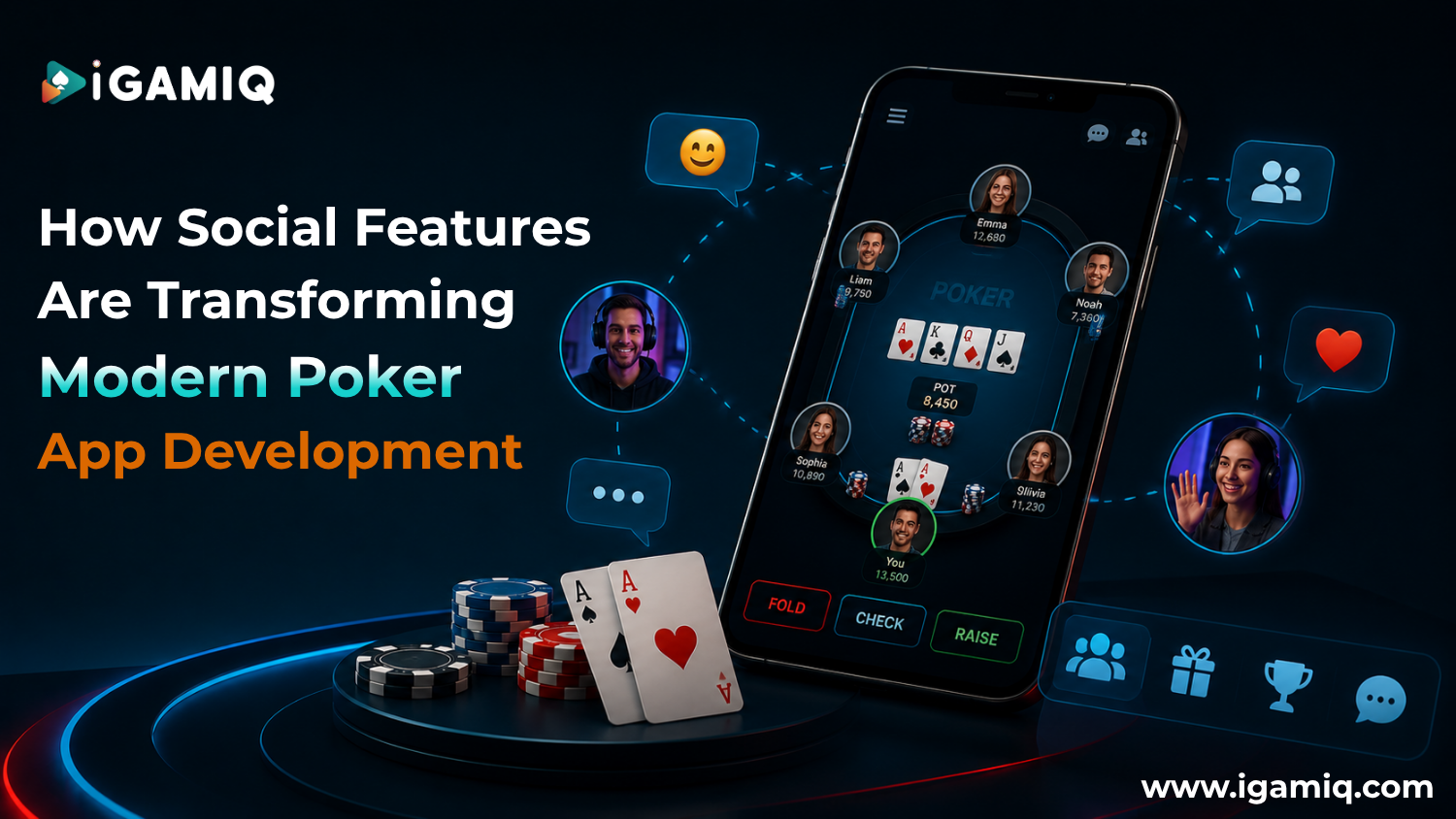
In today’s digital market, the online poker table has completely changed. It no longer sits in a quiet corner of the internet where a single player clicks through hands against anonymous opponents. Today, that table is loud, lively, and full of conversation thanks to the modern poker app development. The transformation in the Poker game industry happened just because developers started treating poker not as a solitary card game but as a shared human experience.
Social features have completely changed the rules of poker app creation. The old simple poker game interface of cards and chips now includes social features, like chat windows, friend lists, team clubs, live leaderboards, and shareable achievements. These additional social features have made modern poker applications into destinations where players return for the people they play with. This guide covers how modern social features transform the old poker games into modern poker app development and why iGamiq is the best solution provider for this.
Table of Contents
From Isolation to Interaction: Modern Poker App Development
Early poker apps focused on replicating the mechanics of Texas Hold’em or Omaha as accurately as possible. Developers preferred the shuffle algorithms, blind structures, and hand rankings. The player meets with strangers through an automated queue. When the hand ended, the connection ended. It all can be done without any conversation or relationship.
That model worked for some time, but it ignored a basic truth about poker. The modern poker game, whether played in a casino or a basement, is social. Players read each other and learn from each other. Removing that social layer left online poker feeling cold and mechanical.
Modern poker app developers have corrected that mistake. They studied how people actually behave when they enjoy a game. They noticed that players stay when they can talk. They return when they feel part of a group. They spend money when the experience feels alive. So the industry shifted toward modern poker app development.
Core Social Features Reshaping Poker Platforms
Several specific social features have driven this transformation from traditional to modern app development. Each one addresses a different aspect of human connection.
1. Real-Time Messaging
Real-time chat sits at the top of the list of social features in modern poker app development. A simple chat box placed next to the table changes everything. Players congratulate a good bluff when they win it. They groan at a bad beat when they lose. They exchange quick greetings with familiar usernames. This small addition removes the silence that once made online poker feel like playing against robots.
2. Private Clubs and Teams
Private clubs and teams have taken engagement to another level in today’s modern poker app development. Instead of random matchmaking, players can now form persistent groups. A club might consist of coworkers, old friends, and international players who share a love for a specific poker variant.
Inside the club, members host private tournaments, track statistics, and build rivalries that last for months. This sense of belonging keeps the app installed on their phones long after a generic app would have been deleted.
3. Leaderboards and Achievement Systems
A leaderboard that resets weekly gives players a reason to return every few days, and achievement systems that reward specific actions, like winning 3 hands in a row or eliminating a certain number of opponents, turn the game into a personal challenge. These features work because they tap into the same motivation that drives people to improve at any skill.
4. Friend Lists and Invite Systems
Friend lists and invite systems solve the problem of empty tables in modern poker app development. A player can see which of their contacts are currently online, and they can jump into a game together instantly. The invite system turns poker into a social activity, not a solo grind. This simple connectivity has proven more effective at retaining users than any bonus or promotion.
5. Gifting and Emoji Reactions
Gifting and emoji reactions add a layer of emotional expression without requiring text. A well-timed trophy emoji or a virtual chip gift can communicate respect, teasing, or celebration in a split second. These lightweight interactions keep the game moving while still preserving the social atmosphere.
Players Stay Longer in Modern Poker App Development
The measurable impact of social features in modern poker apps appears in session length and retention rates. A player who joins a random table stays for 15 to 20 minutes. A player who enters a club tournament with friends stays for over an hour. The difference is not the quality of the cards. It is the quality of the company.
In modern poker applications, trending social features also reduce the frustration of losing. A bad beat against a stranger often leads to rage-quitting. The same bad beat against a friend leads to laughter and a rematch request. Modern Poker Game developers who understand this dynamic build apps where losses do not drive users away. Instead, losses become part of the ongoing story between players.
Technical Challenges of Building Social Poker
Adding social features in modern poker app development is not simple for developers. They face real technical hurdles.
- Real-time chat features require low-latency servers.
- Live tournaments with hundreds of players demand a scalable architecture.
- Friend lists and clubs need databases that can handle complex relationship mapping across thousands of users.
- Moderation presents another challenge.
- Unfiltered chat can turn toxic quickly, so developers need to build reporting systems, automated filters, and moderation tools without making the chat feel censored or sterile.
- Balancing freedom and safety is an ongoing effort, so cross-platform consistency adds another layer of safety.
- A player on an Android must see the same chat messages and club activity as a player on an iOS tablet or a Windows desktop. Maintaining this seamless experience across operating systems requires careful engineering.
The Shift in Development Priorities
5 years ago, poker app developers spent most of their time creating game logic and random number generation. Today, they no longer dominate the roadmap. The majority of modern poker app development efforts now go into social infrastructure.
- Teams design user profiles, build friend recommendation algorithms, create club management interfaces, and test chat moderation systems.
- The poker hand itself is almost secondary. As long as the cards deal fairly and the bets calculate correctly, the game mechanics fade into the background. The social layer becomes the product.
This shift in development priorities has changed hiring priorities as well. Poker studios now recruit backend engineers with experience in real-time messaging systems. They hire community managers to oversee clubs and tournaments.
They employ UI designers who specialize in social interaction patterns. The skill set required to build a successful poker app has expanded far beyond card game expertise.
Business Case for Social Poker Game Development
From a business and revenue perspective, socially connected players spend more. They buy club memberships, purchase virtual gifts, and enter paid tournaments that their friends have joined. The social features create natural upsell opportunities that do not feel aggressive because the spending is tied to shared experiences.
Retention on social media-connected poker games also improves dramatically. A player who belongs to a club with 10 active members will not abandon the app unless the entire group leaves together. That kind of stickiness is rare in mobile gaming. Social features create it.
The transformation of poker game development is not finished yet. Future poker apps will integrate voice chat, live video, and shared spectator modes where friends watch each other play. Clubs will shift into full-fledged communities with their own rules, rankings, and traditions. The line between a poker app and a social network will continue to blur.